
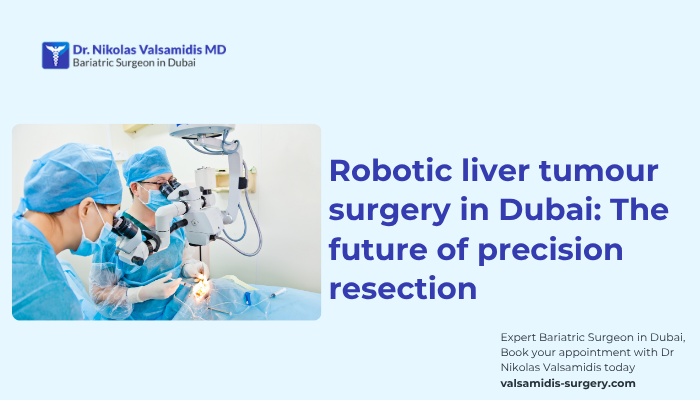
Liver cancer and other liver tumors can present significant challenges for both patients and surgeons. Few organs in the human body carry as much responsibility as the liver. Its dense network of blood vessels and the critical role it plays in keeping the body functioning make surgical treatment here a discipline that demands both deep expertise and exceptional precision.
For decades, open surgery was considered the standard approach for removing liver tumors. Traditional procedures have saved countless lives, but they also demanded a great deal from patients, with larger incisions, prolonged hospital stays, and recoveries that stretched on far longer than necessary.
With a career built at the forefront of hepatobiliary and robotic surgery, Dr. Nikolas Valsamidis doesn’t believe in one-size-fits-all care. He brings advanced surgical expertise and a deeply personalised approach to every patient he treats, because no two conditions are the same, and neither should the care be.
The landscape of liver tumour surgery in Dubai is changing. Robotic-assisted techniques are bringing together surgical expertise and cutting-edge technology to deliver highly precise tumour removal while keeping healthy liver tissue intact.
For patients facing a liver tumor diagnosis, understanding how robotic surgery works and how it differs from conventional techniques can help them make informed treatment decisions.
Understanding liver tumors
A liver tumor refers to an abnormal growth of cells within the liver. These tumors may be benign (non-cancerous) or malignant (cancerous).
Common liver tumors include:
- Hepatocellular carcinoma (HCC)
- Cholangiocarcinoma (bile duct cancer)
- Metastatic liver tumors (cancers that spread from other organs)
- Hepatic adenomas
- Focal nodular hyperplasia
- Hemangiomas
Symptoms of liver tumors
Many liver tumors may not cause symptoms in their early stages. As the condition progresses, patients may experience:
- Persistent abdominal pain
- Unexplained weight loss
- Fatigue
- Loss of appetite
- Nausea
- Jaundice (yellowing of the skin and eyes)
- Abdominal swelling
- A feeling of fullness after eating small amounts
Because symptoms can be subtle, imaging studies and specialist evaluation play a critical role in diagnosis.
How are liver tumors diagnosed?
Before planning liver tumour surgery, a comprehensive assessment is essential.
Diagnostic evaluation may include:
- Liver function blood tests
- Tumor marker testing (such as AFP)
- Ultrasound
- CT scan
- MRI scan
- PET scan in selected cases
- Liver biopsy when necessary
The goal is to determine:
- Tumor size
- Tumor location
- Number of lesions
- Relationship to blood vessels
- Overall liver function
- Presence of disease elsewhere in the body
This information helps surgeons decide whether surgical removal is the most appropriate treatment option.
What is robotic liver tumour surgery?
Robotic liver surgery is a minimally invasive surgical technique that allows surgeons to remove liver tumors using robotic-assisted technology.
Contrary to a common misconception, the robot does not perform the operation independently. Every movement is controlled by the surgeon through a sophisticated console that translates hand movements into highly precise surgical actions.
The robotic system provides:
- High-definition 3D visualization
- Magnified surgical views
- Enhanced dexterity
- Tremor filtration
- Greater precision in confined spaces
Nowhere are these capabilities more critical than in liver surgery, where the margin for error is small and the importance of preserving healthy tissue, while respecting every major blood vessel, is absolute.
As robotic technology continues to evolve, liver tumour surgery in Dubai is increasingly incorporating robotic-assisted techniques for carefully selected patients.
How robotic technology enhances liver surgery?
Liver resections require meticulous planning and precise execution.
Robotic platforms offer several advantages:
Enhanced visualization
Surgeons operate using a high-definition three-dimensional view that provides exceptional detail of liver anatomy.
Superior precision
Robotic instruments can move with a greater range of motion than the human wrist, allowing surgeons to navigate around delicate structures more effectively.
Better preservation of healthy liver tissue
The precision of robotic surgery helps surgeons remove tumors while preserving as much healthy liver tissue as possible.
Improved access
Tumors located in difficult-to-reach areas may sometimes be approached more effectively using robotic techniques.
Reduced blood loss
Advanced visualization and precise dissection may contribute to lower intraoperative blood loss in selected cases.
Types of liver resections that can be performed robotically
Depending on the tumor’s size and location, various procedures may be performed.
Wedge resectionRemoval of a small portion of liver tissue containing the tumor. | SegmentectomyRemoval of one specific liver segment. |
SectionectomyRemoval of multiple adjacent segments. | HemihepatectomyRemoval of either the right or left half of the liver. |
Not every patient is a candidate for robotic surgery. Suitability depends on tumor characteristics, liver function, previous surgeries, and overall health.
Robotic vs traditional liver surgery
Feature | Robotic liver surgery | Traditional open surgery |
Incision Size | Small incisions | Large abdominal incision |
Visualization | High-definition 3D view | Direct visual view |
Surgical Precision | Enhanced instrument control | Limited by hand movement |
Blood Loss | Often reduced | Typically higher |
Hospital Stay | Usually shorter | Usually longer |
Postoperative Pain | Generally less | Often greater |
Recovery Time | Faster for many patients | Longer recovery period |
Scarring | Minimal | More visible |
While robotic surgery offers numerous advantages, open surgery remains the most appropriate option in certain complex cases.
Procedure overview
Before surgery
- A thorough medical evaluation to understand your full health picture
- A careful review of your imaging, so nothing is missed or overlooked
- An honest conversation with our anesthesia team to make sure you’re fully prepared
- Blood work to check how your liver is doing and ensure your body is ready
- A dedicated counseling session before your procedure, because you deserve to go in informed, supported, and at ease
During surgery
- Small incisions are created.
- Robotic instruments are inserted.
- The surgeon operates from a nearby console.
- The tumor is carefully identified and removed.
- Blood vessels and bile ducts are preserved whenever possible.
- The specimen is removed safely.
- Incisions are closed.
The procedure may take several hours depending on complexity.
Recovery after robotic liver tumour surgery
While recovery is always individual, the postoperative course is frequently smoother and less demanding than that of traditional open surgery.
Typical recovery timeline
Recovery stage | What to expect |
Day 1–2 | Walking with assistance, pain management |
Day 2–5 | Gradual return to eating and movement |
Week 1–2 | Increased daily activity |
Week 3–6 | Continued healing and improved energy |
Week 6–8 | Return to many normal activities |
Patients should always follow their surgeon’s individualized recommendations.
Benefits of robotic liver tumour surgery
- Smaller incisions that minimise trauma to the body
- Noticeably reduced pain in the days following surgery
- Lower blood loss, reducing risk and supporting faster healing
- A shorter hospital stay from day one
- A quicker, smoother return to everyday life
- Surgical precision taken to an entirely new level
- Better cosmetic results with significantly less visible scarring
- Superior visualisation that gives the surgeon a critical advantage
These advantages have contributed to the growing adoption of robotic-assisted liver tumour surgery in Dubai and globally.
Risks and limitations
Like all surgical procedures, robotic liver surgery carries potential risks.
These may include:
- Bleeding
- Infection
- Bile leakage
- Blood clots
- Anesthesia-related complications
- Injury to surrounding structures
- Need to convert to open surgery if necessary
An experienced hepatobiliary surgeon carefully evaluates each patient to minimize these risks.
Preparing for robotic liver surgery
Patients can help optimize surgical outcomes by:
- Stopping smoking if applicable
- Maintaining good nutrition
- Following medication instructions
- Managing diabetes and other chronic conditions
- Staying physically active as advised
- Completing all required preoperative tests
Open communication with the surgical team is essential throughout the treatment journey.
Why precision matters in liver cancer surgery?
The liver has a remarkable ability to regenerate, but preserving healthy tissue remains critically important. Successful liver tumor treatment is not just about removing the cancer, it is equally about making sure enough functioning liver tissue remains afterward.
Robotic technology enables surgeons to perform highly precise resections while carefully protecting healthy structures. Striking the right balance between effective tumor removal and tissue preservation is one of the most significant advances that modern hepatobiliary surgery has seen.
As technology continues to evolve, robotic platforms are expected to play an increasingly important role in the future of liver tumour surgery in Dubai, offering patients access to sophisticated treatment options with the goal of improved surgical outcomes.
When should you consult a specialist?
You should seek Dr. Nikolas Valsamidis evaluation if you:
- Have been diagnosed with a liver tumor
- Have chronic liver disease
- Experience unexplained abdominal symptoms
- Have abnormal liver imaging findings
- Require a second opinion regarding treatment options
Early evaluation can significantly influence treatment success and long-term outcomes.
Consult Dr. Nikolas Valsamidis for advanced liver tumour surgery in Dubai
If you have been diagnosed with a liver tumor or are exploring surgical treatment options, seeking expert evaluation is an important first step. From comprehensive assessment to personalised treatment planning, Dr. Nikolas Valsamidis brings advanced surgical expertise to every patient, including the use of robotic-assisted liver surgery when it is the right fit.
Book a consultation and take the first step toward clarity, a dedicated space to talk through your diagnosis, explore your options, and receive guidance that’s built entirely around you.
FAQs
Yes, the liver can regenerate after surgery, with healthy tissue growing back to restore normal function. How well this happens depends on the patient’s liver health and how much was removed.
Most of the patients return to light activities within 2–4 weeks and resume normal routines within 6–8 weeks. Recovery may be faster compared to traditional open surgery.
Robotic surgery offers real advantages, more precision, smaller cuts, and a quicker road to recovery. But what matters most is finding the right approach for you, not just the latest one.
For most patients, a full and fulfilling life after recovery is absolutely achievable and it’s what every treatment decision is built around. Long-term outcomes depend on overall health and how well the liver continues to function.


RYGB Surgery and the Blood-Brain Barrier: Why Alcohol Sensitivity Skyrockets Post-Op
For many patients, life after bariatric surgery brings significant health improvements, including weight loss, better blood sugar control, and reduced

Robotic liver tumour surgery in Dubai: The future of precision resection
Liver cancer and other liver tumors can present significant challenges for both patients and surgeons. Few organs in the human

Hiatal hernia exercises to avoid: safe and unsafe practices
Quick answer: What exercises should I avoid with a hiatal hernia? Exercising with a hiatal hernia can be tricky. Certain

The hiatal hernia diet: what to eat and what to avoid
Do you know what should you eat if you have a hiatal hernia? For those living with a hiatal hernia,